The Permanence Compulsion: Why Americans Build Cathedrals for Temporary Concerns
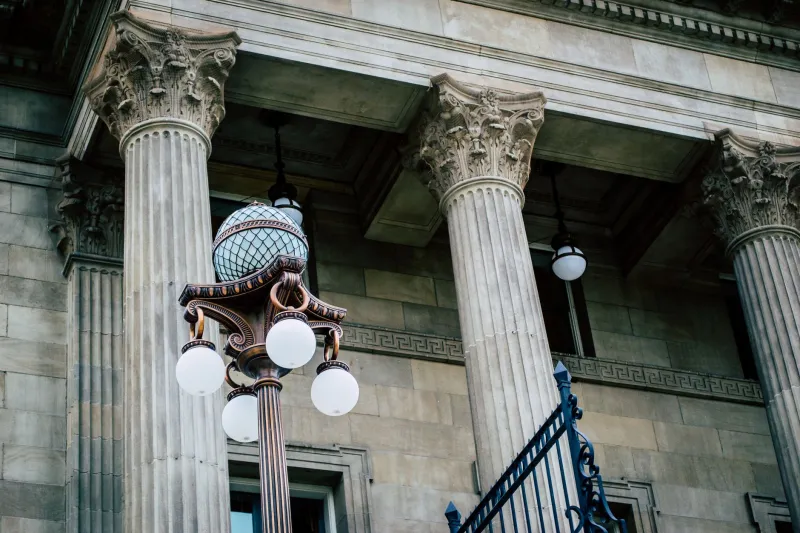
In 1871, the citizens of a prosperous Ohio river town voted to construct a new county courthouse at a cost that exceeded the assessed value of every farm within ten miles. The building was to be faced in limestone. The columns were to be Corinthian. The dome, it was specified in the contract, should suggest permanence. Forty years later, the county seat had moved, the river trade had died, and the building stood largely empty, a monument to the confidence of men who could not have imagined that the conditions sustaining their prosperity were as mortal as they were.
This is not a story about foolishness. It is a story about psychology—specifically, about the human need to impose permanence on a world that declines to cooperate. History, which has been running this particular experiment for considerably longer than any university laboratory, has returned the same result with striking consistency: human beings, when prosperous and frightened in equal measure, build things designed to outlast them.
The Anxiety Behind the Cornerstone
To understand why Americans have invested so disproportionately in permanent structures for temporary purposes, it helps to understand what permanence actually purchases. It is not, as the economic case would suggest, a rational hedge against future costs. The limestone courthouse in Ohio was not cheaper over a century than a serviceable wooden structure would have been; it was vastly more expensive, and it outlasted its usefulness by decades that required ongoing maintenance.
What permanence purchases is psychological relief. The cornerstone ceremony, the brass plaque, the constitutional language drafted to echo across centuries—these are not practical decisions. They are assertions against mortality, conducted in stone and statute, by people who understood at some level that they and their concerns were temporary and found that understanding intolerable.
This is not a character flaw. It is one of the most consistent features of human psychology that the historical record documents. The Egyptians built in granite. The Romans poured concrete. The medieval guilds commissioned stained glass. Each generation, in each culture, found its own material for the same project: making the present moment feel like it would last.
The Corporate Cathedral
American business history offers some of the most instructive examples of this compulsion, precisely because business decisions are supposed to be rational in ways that civic and religious ones are not. The late nineteenth and early twentieth centuries produced a remarkable wave of corporate construction that can only be understood through this psychological lens.
The great bank buildings of the Gilded Age were not designed for operational efficiency. They were designed to inspire awe—specifically, the particular form of awe that persuades a depositor that his money is safe because the institution holding it appears capable of outlasting geological time. The marble, the vaulted ceilings, the bronze fittings: these were not amenities. They were arguments, conducted in architecture, about permanence and trustworthiness.
The argument worked, which is why it was repeated. But it also reveals something important about the relationship between apparent permanence and actual stability. Several of the most magnificently constructed bank buildings in American history housed institutions that failed within decades of their completion. The building outlasted the bank. The permanence was a performance, and the performance was directed at the psychological needs of the audience rather than the operational realities of the enterprise.
Laws Written for Eternity
The compulsion extends beyond construction into legislation, and nowhere more visibly than in the American constitutional tradition. The founding generation, operating under conditions of genuine uncertainty about whether the republic would survive its first decade, drafted a document intended to govern for ages. This was an admirable ambition. It was also, in several respects, a psychological projection of their particular moment onto all future moments.
The result has been a recurring tension between constitutional language written for permanent application and social conditions that have changed beyond recognition. The amendment process, designed to be difficult, reflects the founders' conviction that the document's value lay partly in its resistance to revision—in its permanence. What this produced, across two centuries, was a series of increasingly baroque interpretive maneuvers required to apply eighteenth-century language to twenty-first-century circumstances.
This is not a political observation. It is a psychological one. The founders were not unusual in their desire to write for eternity; they were entirely typical. Every generation that has held power has attempted, through some combination of law, architecture, and institutional design, to extend its influence beyond its natural lifespan. The American founders simply had an unusually effective mechanism for doing so.
The Business of Outlasting Yourself
In the corporate sphere, the permanence compulsion has taken forms that are easier to measure and therefore more instructive. The conglomerate-building era of the 1960s and 1970s produced enterprises explicitly designed around the premise that diversification into unrelated industries would create organizations too complex and too broadly rooted to fail. The logic was appealing: if no single industry could destroy you, you would last forever.
The historical record was not encouraging about this theory, but the theory was not really a business proposition. It was a psychological one. The executives who assembled these sprawling enterprises were not primarily motivated by return on investment projections; they were motivated by the desire to build something that would outlast them. The conglomerate was a monument. It happened to be organized as a corporation.
Most of those conglomerates have since been dissolved, their component parts sold to specialists who understood that focus was more durable than breadth. The monuments did not last. They rarely do.
What Temporary Things Actually Require
History's most useful lesson on this subject may be the one that the permanence compulsion most aggressively resists: most things are temporary, and designing them as though they are not makes them more expensive, less adaptable, and ultimately no more durable.
The American towns that survived the industrial transitions of the twentieth century were not, as a rule, the ones with the most impressive courthouses. They were the ones whose institutions had been built with sufficient flexibility to accommodate purposes their founders had not anticipated. The wooden building that could be repurposed outlasted the limestone monument that could not.
This is not an argument against quality or investment. It is an argument against confusing the psychological need for permanence with the practical requirements of endurance. The ledger of American building—civic, corporate, and constitutional—is full of structures that expressed their creators' anxiety about mortality with great eloquence and at great expense. History, reading that ledger with the detachment that only time provides, notes that the anxiety was justified. The structures were not the answer to it.