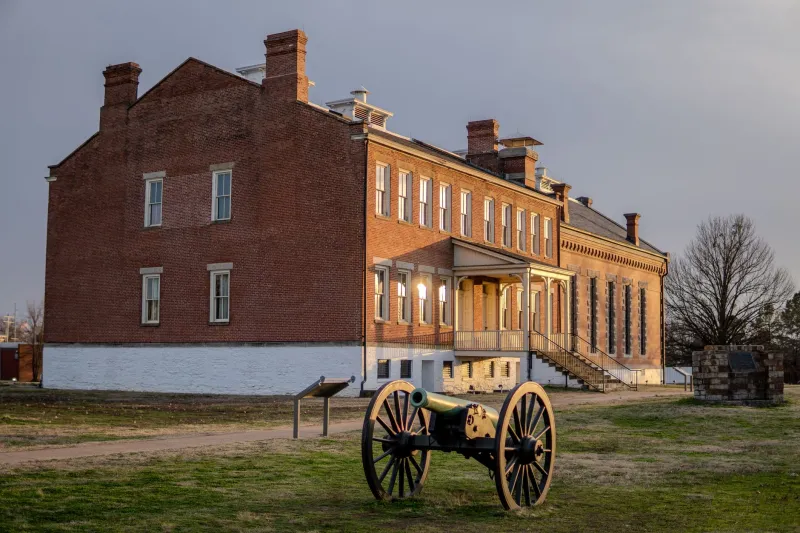
Stitched Together After the Fact: The Invented History of America's Most Contested Symbol

Photo by Photo by Drew Beamer on Unsplash on Unsplash
Stitched Together After the Fact: The Invented History of America's Most Contested Symbol
On June 14, 1777, the Second Continental Congress passed a resolution stating that the flag of the thirteen United States should consist of thirteen stripes, alternating red and white, and thirteen stars on a blue field. The resolution offered no further detail. It specified no arrangement of stars, no precise dimensions, no manufacturer, and no ceremony. It was, in the language of legislative history, a housekeeping measure — the kind of administrative notation that fills the gaps between the decisions that actually matter.
No one recorded a debate. No one appears to have considered it significant enough to discuss at length. The Congress had, at the time, rather more pressing concerns, including the ongoing question of whether the nation whose flag it was designing would survive the year.
For the better part of a century, the resolution sat in the record largely undisturbed. There was no standardized flag. Naval vessels flew variations that differed from state militias, which differed from what individual commanders chose to carry. The flag was a concept more than an object, and Americans of the early republic treated it with approximately the reverence one extends to a memo.
Then something changed. And what changed reveals considerably more about human psychology than it does about textile history.
The Machinery of Myth
The Betsy Ross story did not enter the public record until 1870, nearly a century after the events it purported to describe. It arrived through the testimony of her grandson, William Canby, who told the Historical Society of Pennsylvania that his grandmother had personally sewn the first American flag at the request of George Washington, Robert Morris, and George Ross in the spring of 1776. The story was vivid, detailed, and entirely unverifiable. No contemporary document supported it. No letter, no diary entry, no account book — nothing from 1776 or the years immediately following — placed Betsy Ross in a room with the founders discussing flag geometry.
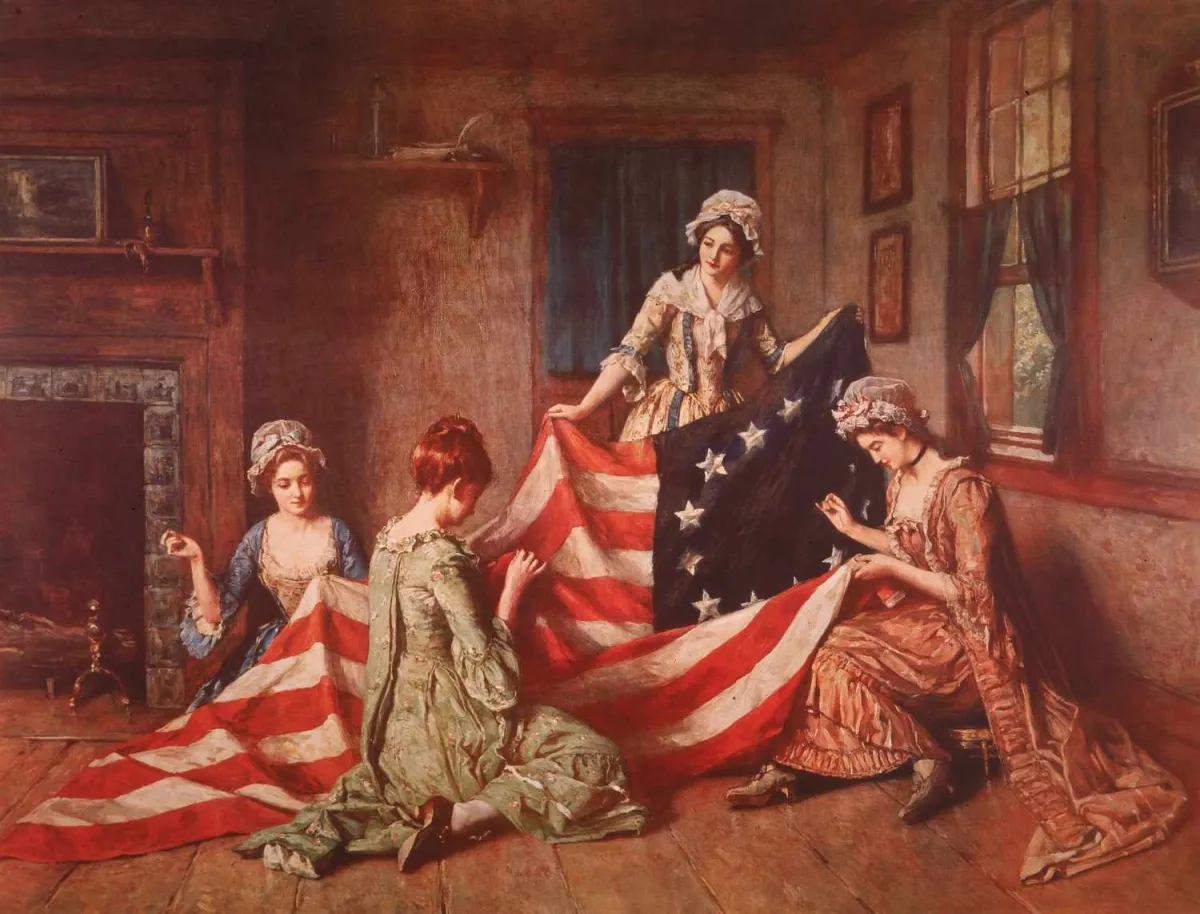 Photo: Betsy Ross, via www.thoughtco.com
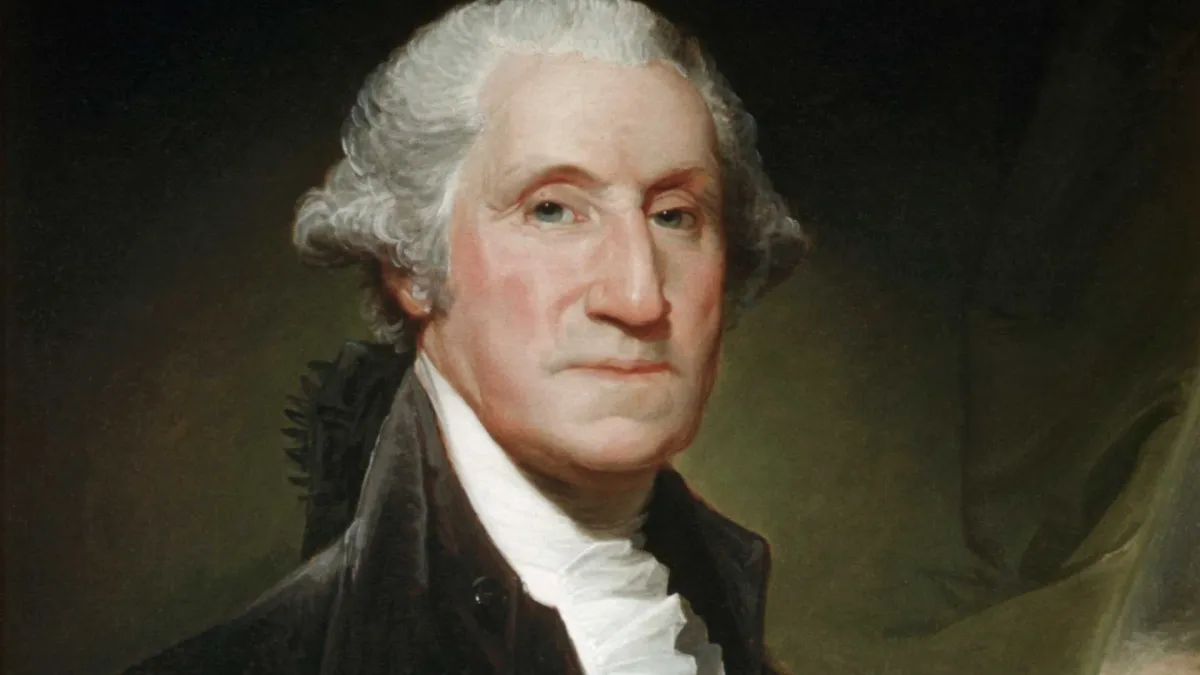 Photo: George Washington, via res.cloudinary.com
Canby acknowledged as much. His evidence was family oral tradition, transmitted across three generations in a country that had recently survived a civil war and was in the middle of a centennial celebration that required usable national symbols.
The timing was not coincidental. It never is.
Historians of nationalism have documented this pattern across cultures and centuries with a consistency that should, by now, surprise no one. Symbols acquire elaborate origin stories not when nations are confident but when they are anxious. The more contested the national identity, the more urgent the demand for a mythology that appears to settle the contest. The story does not need to be true. It needs to be emotionally satisfying and structurally simple — a great man, a humble craftsperson, a moment of creation that feels like destiny.
What the Flag Actually Was
Before it was sacred, the American flag was a commercial and military identifier. Ships flew flags to communicate nationality, allegiance, and intent. Armies carried standards to maintain unit cohesion in the chaos of battle and to mark territory. These were practical instruments, not devotional objects, and they were treated accordingly — replaced when worn, modified when convenient, abandoned when tactically advisable.
The transformation of the flag from a functional object into a sacred one required infrastructure. It required public education systems that could transmit a standardized narrative to children. It required veterans' organizations that could deploy the symbol in emotional contexts. It required a commercial market for flags and flag-adjacent merchandise that had an economic interest in promoting reverence. It required, above all, a political environment in which appeals to national unity served the interests of those making them.
All of these conditions converged in the decades following the Civil War. The nation had just fought the bloodiest conflict in its history over questions of union and identity that the founding documents had deliberately left ambiguous. The centennial of 1876 created both a deadline and an opportunity. Someone needed to tell a story about what America was, and the flag — which had been present at the founding and had survived the war — was available to carry that story.
The Economics of Reverence
Symbols that inspire reverence generate revenue. This is not a cynical observation but a historical one, and the American flag is among the cleaner examples in the ledger. The late nineteenth century saw the rise of a substantial flag industry — manufacturers, distributors, retailers — whose commercial interests aligned precisely with the promotion of flag veneration. Flag Day, which was observed locally and informally for decades before Congress established it nationally in 1949, was championed by educators, civic organizations, and commercial interests in a coalition that would be recognizable to any modern marketing professional.
The content of the mythology also served specific interests. The Betsy Ross narrative placed the flag's origin in Philadelphia, in the hands of a working woman of modest means, at the direction of the most revered figures of the founding generation. It was, in structural terms, a masterpiece of inclusive symbolism — democratic in its protagonist, aristocratic in its patrons, and sufficiently vague in its details to resist effective falsification. A story designed by committee to offend no one could hardly have been better engineered.
The American flag's legal status followed the mythology rather than preceding it. Flag desecration laws appeared at the state level beginning in the 1890s, a direct response to perceived commercial misuse of the symbol — primarily its appearance in advertising. The first instinct of the flag protection movement was not to protect the flag from political dissidents but from soap manufacturers. The sacred and the commercial were, from the beginning, in an awkward negotiation that has never been fully resolved.
Unresolved Arguments That Stopped Being Argued
What a national symbol actually represents, stripped of the mythology layered over it, is a suspended dispute. The flag does not resolve the question of what America is. It provides a shared object around which people who hold incompatible answers to that question can stand together without immediately fighting about it. This is not a small achievement. It may be the primary social function of national symbols in any era.
The psychological mechanism is straightforward and has been observed in every culture that has produced durable symbols: ambiguity is a feature, not a defect. A flag that meant precisely one thing would belong to precisely one faction. A flag whose meaning is contested but whose sanctity is agreed upon can be claimed by everyone, which is why arguments about what the flag stands for are so persistent and so heated — each claimant understands, at some level, that winning the argument about meaning is equivalent to winning the argument about the nation itself.
Harvey Wiley wanted to regulate what went into the medicine cabinet. The men who built the flag's mythology wanted to regulate what went into the national memory. Both were engaged in the oldest business in the historical record: the management of what people believe, in service of outcomes they considered worth pursuing.
The resolution of 1777 is still in the archive, brief and uninstructive as ever. The mythology built around it is the more revealing document.