The Honorable Exit: Five American Communities That Chose Extinction Over Adaptation

The conventional narrative of American economic history is Darwinian in its optimism. Communities adapt. Industries reinvent themselves. The creative destruction of the market produces new growth from old wreckage. It is a story Americans tell about themselves with great conviction, and it is, like most stories told with great conviction, selectively true.
The cases that do not fit the narrative are rarely examined with equivalent attention, because they are less flattering and considerably less useful as mythology. But the old ledger does not curate its entries for inspirational value. It records what happened, and what happened, with notable frequency, is this: a community faced a choice between transformation and termination, understood the choice clearly, and chose termination.
The psychology behind that choice is not irrational, though it is often described that way by economists who mistake preference for error. It is, in fact, one of the most consistent patterns in the human record — the preference for a conclusion that preserves meaning over a continuation that destroys it. Five American cases illuminate the pattern with particular clarity.
1. The Mill Towns That Refused the Railroad
In the decades following the Civil War, the expansion of the American railroad network presented every established manufacturing town in the Northeast and Mid-Atlantic with a version of the same proposition: accept the disruption of rail access, including the reconfiguration of local supply chains, the devaluation of existing canal and road infrastructure, and the influx of outside capital and outside workers, or remain as you are and watch the economy reorganize itself around communities that said yes.
Several mill towns, particularly in New England, said no — not because they failed to understand the offer, but because they understood it perfectly. The railroad did not merely promise transportation. It promised transformation. Existing mill owners, who had built their operations around water-power sites and local labor networks that took decades to develop, correctly recognized that rail access would benefit new entrants more than established operators. The capital investments they had already made would be devalued. The competitive advantages they had accumulated would be erased.
The towns that refused rail connections did not collapse immediately. Some sustained themselves for a generation on the momentum of their existing operations. But the trajectory was fixed from the moment of refusal, and the men who made that choice knew it. They chose the dignity of a slow decline on their own terms over the indignity of rapid transformation on someone else's.
2. The Whaling Industry's Deliberate Drowning
The American whaling industry, centered on New Bedford and Nantucket, reached its peak in the 1850s and faced a straightforward competitive threat from petroleum, which began displacing whale oil in the illumination market after Edwin Drake's 1859 Pennsylvania well. The capital, organizational expertise, and maritime infrastructure accumulated in the whaling industry were, in principle, transferable to other applications. Some whaling families did make the transition, investing in textile manufacturing and other industrial enterprises.
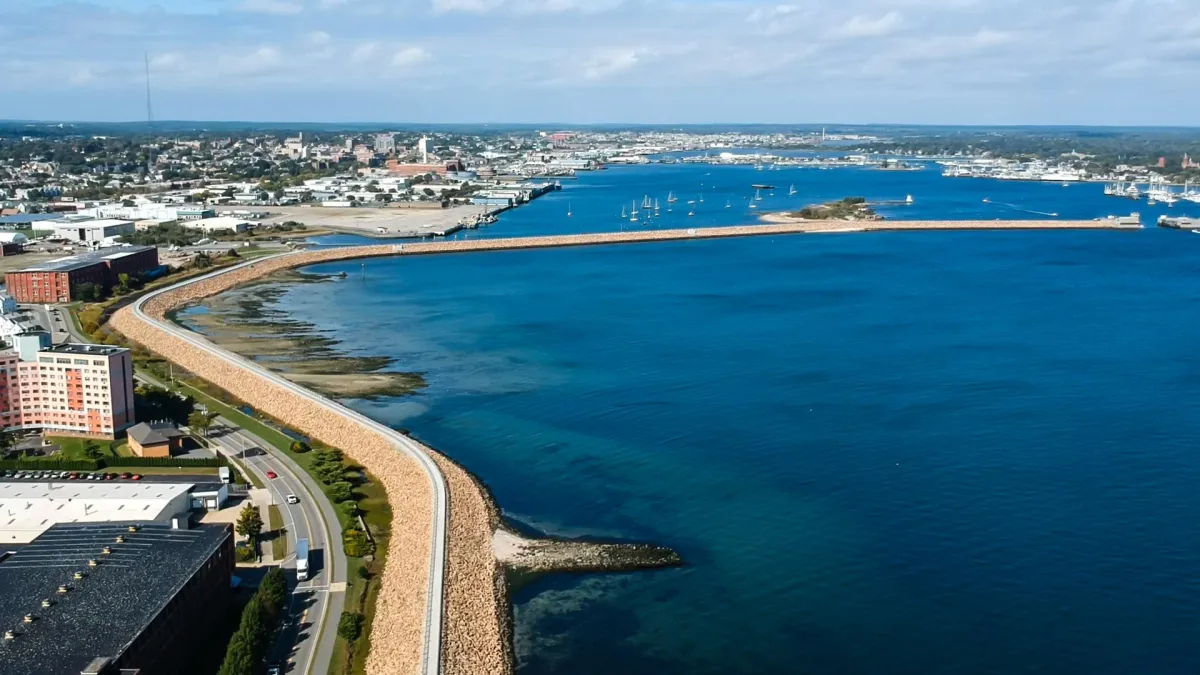 Photo: New Bedford, via explorenewbedford.org
But a significant portion of the industry's leadership chose not to. The decision was cultural as much as economic. Whaling was not merely a business; it was an identity, a social structure, and a source of status that had organized entire communities for generations. The skills it required, the hierarchies it produced, and the values it rewarded were specific to itself and not easily translated. Men who were captains in the whaling trade would not be captains in the textile trade, and the distinction mattered to them in ways that balance sheets did not capture.
The industry's decline was, in this sense, partly chosen. Capital was not reinvested. Younger generations were not trained into the trade in sufficient numbers to sustain it. The infrastructure was allowed to age without replacement. The ledger records this not as failure but as a collective decision about what kind of life was worth living — a decision that reasonable people, facing the same circumstances, might make again.
3. The Farming Cooperative That Litigated Itself to Death
In the 1920s and 1930s, several agricultural cooperatives in the Great Plains organized themselves with sufficient legal sophistication to pursue antitrust and contract disputes against grain elevator operators, railroad companies, and commodity processors. The legal strategy was, in some cases, sound. The underlying grievances were legitimate. The problem was that the cooperatives pursued litigation as a primary strategy rather than a supplementary one, diverting resources from operational development to legal fees at precisely the moment when operational development was the only thing that could have saved them.
The psychology was recognizable: the cooperatives were composed of farmers who had been genuinely wronged by the market structures they were fighting, and who found it more satisfying to prosecute that wrong through the courts than to accept a compromise that would have required acknowledging the limits of their position. Several cooperatives that were financially viable in 1925 were bankrupt by 1935, having spent their reserves on legal campaigns that they occasionally won and that never produced the structural changes they sought.
The choice was not stupidity. It was a preference for the clarity of a fight over the ambiguity of accommodation — a preference the old ledger has observed in every era and on every continent.
4. The Coal Town That Voted Against the Mine
In the mid-twentieth century, as underground coal mining became increasingly mechanized and the labor requirements of the industry collapsed, several coal-dependent communities in Appalachia faced proposals for surface mining operations — strip mining — that would have extended the economic life of local coal reserves at the cost of transforming the landscape and eliminating the underground mining culture that had defined community identity for generations.
Some of these communities, through local political processes, opposed the transition. The opposition was not purely environmental, though environmental concerns were present. It was, more fundamentally, a refusal to accept that a community built around the identity of the underground miner could survive by becoming a community built around the operation of heavy earthmoving equipment. The skills were different, the social structures were different, and the meaning was different.
The communities that made this choice did not prosper. But prosperity, it is worth noting, was not the only thing they were being asked to weigh.
5. The Department Store That Would Not Become a Website
The most recent iteration of this pattern requires no archival research. In the first two decades of the twenty-first century, several regional American department store chains faced the same structural proposition that the mill towns faced in the 1870s: transform, at significant cost to existing identity and organizational culture, or decline on familiar terms.
The chains that chose decline did not all do so passively. Some pursued litigation against competitors. Some lobbied for regulatory protection. Some made partial investments in digital infrastructure that were too limited to produce results and too expensive to sustain. What they generally did not do was commit fully to the transformation required, because full commitment would have required acknowledging that the thing they were transforming into was not the thing they had been — and that the people who had built the existing organization had built the wrong thing for the world that was arriving.
That acknowledgment is, psychologically, very difficult. It was difficult for the mill town owners in 1870, for the whaling captains in 1865, and for the department store executives in 2010. The difficulty is not a product of any particular era. It is a feature of human psychology that the historical record documents with depressing regularity.
The Constant Beneath the Cases
The throughline connecting these five cases is not economic irrationality. In each instance, the actors involved understood their situation with reasonable clarity. What they chose to prioritize — identity, meaning, dignity, the coherence of a way of life — was simply not the same thing that economic survival required them to prioritize.
History does not judge this preference harshly. It records it. The old ledger has entries from ancient grain merchants, medieval guild masters, and nineteenth-century industrialists that follow the same structure: the terms of survival were understood, the terms were found unacceptable, and the alternative was accepted with something that, in the historical record, reads less like despair than like relief.
The lesson is not that communities should choose extinction. It is that the forces driving them toward it are older, more consistent, and more deeply rooted in human psychology than any particular economic theory accounts for. Understanding those forces is the beginning of any serious attempt to address them.