The Floor Plan of Wounded Pride: How Personal Humiliation Quietly Reshaped the American Workplace
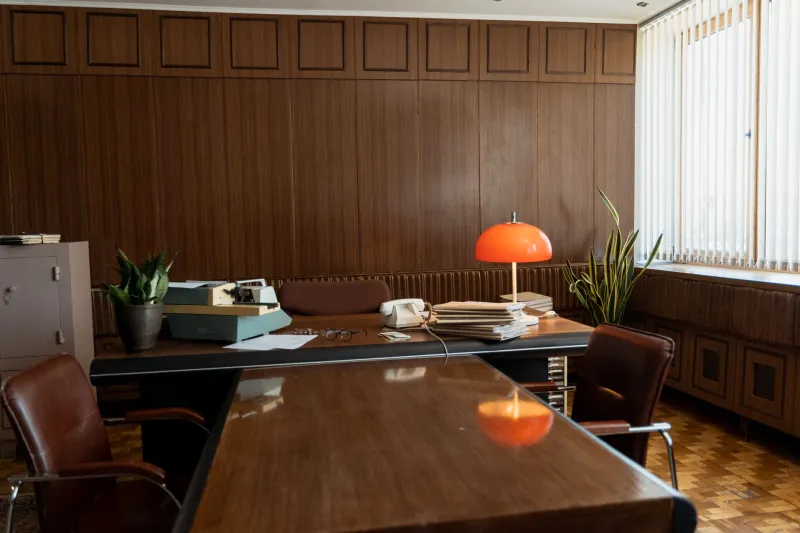
The next time you sit at an open workstation, navigate a glass-walled conference room, or move through an office floor plan that seems to prioritize visibility over privacy, consider the possibility that you are inhabiting someone's argument. Not a business argument, precisely — though it was dressed as one. A personal argument. The kind that begins with a rejection and ends, decades later, with an entire industry reorganized to prove the rejector wrong.
This is not a metaphor. The development of American office design across the twentieth century was driven by genuine innovations in management theory, materials technology, and organizational psychology. But embedded within that developmental history are specific, documented episodes in which the direction of innovation was determined less by evidence than by the emotional needs of the people controlling its implementation. History is the longest psychology study ever run, and it has never recorded a period in which institutional decisions were made by people who had successfully separated their professional judgments from their personal grievances.
The Dismissed Idea and Its Second Life
In the mid-twentieth century, a cluster of designers and architects working at the intersection of organizational theory and spatial planning developed proposals for American office environments that were, by the standards of their time, radical. The conventional American office of the 1940s and early 1950s was a monument to hierarchy made visible: private offices for senior staff, bullpen arrangements for clerical workers, and a spatial grammar that announced status at every threshold.
The proposals that challenged this model — emphasizing open, flexible, reconfigurable space — were not initially welcomed by the corporate clients who commissioned them. The resistance was partly financial, partly cultural, and partly the ordinary institutional conservatism that greets any significant departure from established practice. Proposals were rejected, contracts were declined, and the designers who had invested considerable intellectual capital in new spatial philosophies were sent away with polite but firm refusals.
What happened next is the part that the standard histories of office design tend to present as straightforward professional persistence. It was also something considerably more personal.
Pride as an Architectural Force
The designers who returned — sometimes years later, sometimes with modified proposals, sometimes with new institutional allies — were not returning purely because they believed in the efficiency arguments for open-plan environments. They were returning, in several well-documented cases, because they had been told they were wrong, and the experience of being told so had become the organizing principle of their professional lives.
This is not a criticism. It is an observation about how innovation actually functions in human institutions. The people most likely to push a genuinely new idea through the enormous resistance that institutions generate are rarely those who are motivated primarily by abstract commitment to good design or efficient space utilization. They are frequently people who have made the idea personal — who have fused their professional identity so completely with a specific proposal that its rejection has become their rejection, and its eventual adoption has become their vindication.
The behavioral literature on this is extensive and consistent. Human beings who have experienced public dismissal of an idea they identify with closely do not, as a rule, dispassionately evaluate the evidence and update their positions. They become more committed to the original idea, more attuned to evidence that supports it, and more motivated to find institutional contexts in which it can be implemented. The dismissed designer does not go home and reconsider. The dismissed designer goes home and waits.
The Adoption That Changed Everything
When open-plan office design began its serious penetration of American corporate real estate in the 1960s and 1970s, the arguments made for it were, almost universally, arguments about collaboration, communication flow, and organizational flexibility. These were real benefits, genuinely studied and, in some contexts, genuinely achieved. But they were also the arguments that the original proponents of open-plan design had been making for years before anyone was willing to listen — and the people making them had not forgotten that.
The consequence was an advocacy that was, at its emotional core, less interested in nuance than in vindication. The case for open-plan design was made maximally, without the qualifications that a more dispassionate analysis would have included. The conditions under which open environments produced the claimed benefits — the type of work being performed, the organizational culture, the acoustic environment, the availability of private spaces for focused work — received considerably less attention than the core proposition that openness was better than enclosure.
This matters because those unexamined qualifications turned out to be significant. The wholesale adoption of open-plan principles across American office design produced environments that worked extremely well for certain categories of work and extremely poorly for others. The evidence for this was available relatively early, but the institutional momentum behind open-plan design — momentum that had been generated, in part, by the personal intensity of its advocates — made the evidence difficult to act upon.
Institutions and the Emotions That Drive Them
The story of American office design is a particularly legible example of a phenomenon that runs through the entire history of institutional decision-making: the degree to which consequential choices about physical, organizational, and technological infrastructure are made by people whose primary motivation is the resolution of personal narrative rather than the optimization of outcomes.
This is not a failure of institutional design, exactly. It may be an irreducible feature of it. Institutions are operated by human beings, and human beings do not pursue ideas with the sustained intensity required to overcome institutional resistance unless the ideas have become personally meaningful. The cost of this arrangement is that the ideas which achieve adoption are not necessarily the best ideas — they are the ideas held by people who were sufficiently motivated, for whatever combination of principled and personal reasons, to keep pushing.
The American workplace is full of design choices that trace their lineage not to productivity research or employee satisfaction data but to someone's need to be proven right. The open floor plan is only the most visible example. The corner office, the glass-walled conference room, the hot-desking arrangement, the standing desk — each has its own history, and in each history, if you look closely enough, you will find someone who was told no and refused to accept it.
Reading the Room
For the business historian, the practical value of understanding this pattern is not that it permits us to identify which design choices were emotionally motivated and therefore dismiss them. Emotionally motivated choices are not necessarily wrong. The open-plan advocates were not incorrect that conventional hierarchical office arrangements had significant costs. They were, in some respects, correct in ways their critics were not.
The value is rather that it permits more honest analysis of institutional momentum. When a design principle, a management philosophy, or an organizational structure becomes entrenched across an industry, the standard explanation is that it won because it worked. The historical record suggests a more complicated truth: it won because someone needed it to win, and that need was strong enough to sustain the advocacy required to make winning possible.
The floor plan you work in today is, in some measure, someone else's argument. The question worth asking is not only whether the argument was correct, but whether the premises on which it was made — the conditions, the qualifications, the contexts in which it holds — were ever honestly examined, or whether the examination was cut short by the urgency of proving a point.