The Dignified Decline: When American Towns Chose Pride Over Prosperity

Photo by Photo by Cole Patrick on Unsplash on Unsplash
The standard explanation for why American towns die is economic. The railroad bypassed them, or the factory closed, or the highway interchange was built twelve miles to the east. These explanations are accurate as far as they go. What they omit is the frequency with which the railroad bypass, the factory closure, and the highway placement were not misfortunes visited upon passive communities but decisions actively made — or actively invited — by the communities themselves.
The history of American municipal decline is, in a meaningful number of cases, a history of collective choice. And the choices were not made in ignorance. They were made by people who understood what they were trading away and considered the terms acceptable.
The Railroad Refusals
The mid-nineteenth century railroad expansion produced, as a byproduct, one of the most psychologically revealing phenomena in American commercial history: towns that refused to allow rail lines to pass through their borders and subsequently declined into irrelevance, having made their choice with open eyes.
The refusals took various forms. Some communities objected to the noise and fire hazard of steam locomotives — objections that were not irrational in an era of wooden buildings and no municipal fire departments. Some objected to the land acquisition terms demanded by railroad companies, which were frequently aggressive and sometimes genuinely exploitative. Some objected on the grounds that the railroad would bring undesirable elements — a category that encompassed, depending on the community, laborers, immigrants, saloons, or simply strangers.
But a notable subset of refusals were driven by something that does not fit neatly into any of these categories: the conviction that accepting the railroad's terms would constitute a submission to outside power that the community's self-respect could not accommodate. These towns had been built by people who had made deliberate choices about where and how to live. The railroad's arrival represented a renegotiation of those choices by an external party with more capital and less local attachment, and the renegotiation felt, to many residents, like a form of annexation.
Gilman, Illinois, and dozens of towns like it across the Midwest negotiated with railroad companies in the 1850s and 1860s over right-of-way terms. Some reached agreements. Others did not, and the line went elsewhere, and the towns that had held firm discovered that holding firm was a principle that the market did not reward. Within two decades, many of these communities had lost population, commercial activity, and eventually their post offices — the federal government's own measure of a settlement's viability.
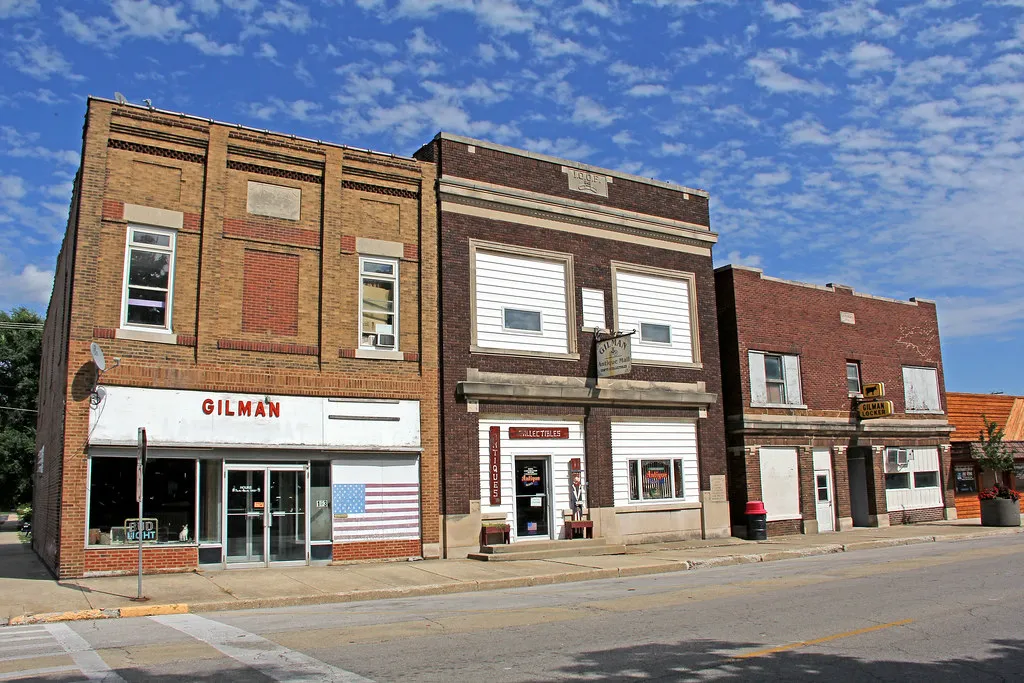 Photo: Gilman, Illinois, via live.staticflickr.com
The people who made these decisions were not fools. Many of them were the same settlers who had successfully homesteaded difficult land, built functioning civic institutions from nothing, and navigated the genuine hardships of frontier life. They understood economic calculation. They simply weighted certain non-economic variables — autonomy, the right to set terms on their own land, the preservation of a particular community character — more heavily than the calculation recommended.
Incorporation and Its Discontents
The refusal to incorporate — to accept formal municipal status with its attendant tax base, legal authority, and access to state infrastructure funding — represents a variant of the same psychology, operating across a different axis.
Throughout the late nineteenth and early twentieth centuries, unincorporated communities across the American South and Midwest resisted incorporation campaigns with arguments that mixed legitimate fiscal conservatism with something that looked, in retrospect, more like territorial instinct. Incorporation meant taxes. It meant a city council with authority over decisions that had previously been made informally, by consensus, among people who knew each other. It meant, in the most fundamental sense, that the community's internal life would become legible to — and partially governed by — external authority.
Several communities in Appalachia and the rural South that declined to incorporate in the 1880s and 1890s subsequently found themselves unable to access state road-building funds, unable to issue bonds for school construction, and unable to attract the commercial investment that preferred the legal certainty of incorporated municipalities. The decline that followed was gradual, measurable, and entirely consistent with what the proponents of incorporation had predicted.
The communities knew this. The debates were not conducted in ignorance of the consequences. They were conducted by people who believed that the consequences were preferable to the alternative — that a poorer, smaller, less-connected community that governed itself on its own terms was worth more than a more prosperous community that had surrendered some portion of its self-determination to achieve that prosperity.
The Psychology Beneath the Arithmetic
What unites these cases — the railroad refusals, the incorporation debates, the development rejections — is a value system that American economic culture has never successfully incorporated into its standard models, because the models assume that communities, like firms, optimize for growth and survival.
They do not always. The historical record is unambiguous on this point. Communities optimize for a range of values, and survival is one of them but not the only one and not always the dominant one. Identity, autonomy, the preservation of a particular social texture, the refusal to be dictated to by outside interests — these have demonstrated, across two centuries of American municipal history, a capacity to outweigh the survival instinct in collective decision-making contexts.
This is not irrationality. It is a different rationality, one that discounts future economic outcomes in favor of present dignity. Behavioral economists have a vocabulary for this — hyperbolic discounting, loss aversion, identity-protective cognition — but the vocabulary was developed from experiments run on undergraduates in laboratory settings. The historical record of American towns making ruinous choices with full awareness of their ruinousness provides a far richer data set, and it suggests that the discounting of future prosperity in favor of present identity is not a cognitive error that better information would correct. It is a stable preference that better information does not change.
What the Dying Towns Understood
There is a final observation that the historical record forces on anyone who examines these cases without condescension: the towns that chose dignity over survival were not wrong about what they were preserving.
The railroad towns that accepted the rail lines on unfavorable terms frequently found that the railroad's arrival did not produce the prosperity promised. The railroad companies extracted concessions, manipulated freight rates, and exercised the kind of leverage over dependent communities that the resisters had feared. Some of the towns that held firm and declined would have declined anyway, on a slightly different timeline, under slightly different pressures.
This does not vindicate the refusals as economic strategy. It does suggest that the people making them were not simply failing to see the future clearly. They were making a judgment about power and dependence that was not without foundation, in a context where the powerful party's promises had a mixed record of fulfillment.
The old ledger records their choices without judgment. It records the consequences without sentiment. What it cannot record — what no ledger can — is whether the towns that chose dignity over survival made the wrong decision, or simply made a decision about what they were willing to survive as.