
The Chancellor's Mathematical Sleight of Hand
In 1889, Otto von Bismarck faced a political crisis that required creative accounting. German workers were growing restless, socialist movements were gaining strength, and the Iron Chancellor needed a policy that would appear generous while costing almost nothing. His solution was mathematically elegant: promise workers a pension at age 65 in a country where average life expectancy hovered around 45 years.
 Photo: Otto von Bismarck, via i.etsystatic.com
The Prussian retirement system wasn't designed as a humanitarian breakthrough; it was a masterpiece of actuarial manipulation. Bismarck's advisors had calculated that fewer than one percent of German workers would live long enough to collect their promised benefits. The program could be announced with great fanfare while imposing minimal fiscal burden on the state—a political win that cost virtually nothing.
This wasn't accidental oversight but deliberate policy design. Bismarck understood that the promise of future security could pacify present discontent, even if that future remained statistically unlikely for most beneficiaries. The age threshold was set high enough to serve as effective political theater while low enough to seem achievable to workers who had no access to mortality statistics.
America Imports a Prussian Fantasy
When Franklin Roosevelt's administration crafted Social Security in 1935, they borrowed Bismarck's framework with remarkable fidelity. The age 65 retirement threshold crossed the Atlantic intact, despite dramatically different demographic and economic conditions in Depression-era America. American life expectancy had improved since Bismarck's era, but not enough to make 65 a reasonable expectation for most workers.
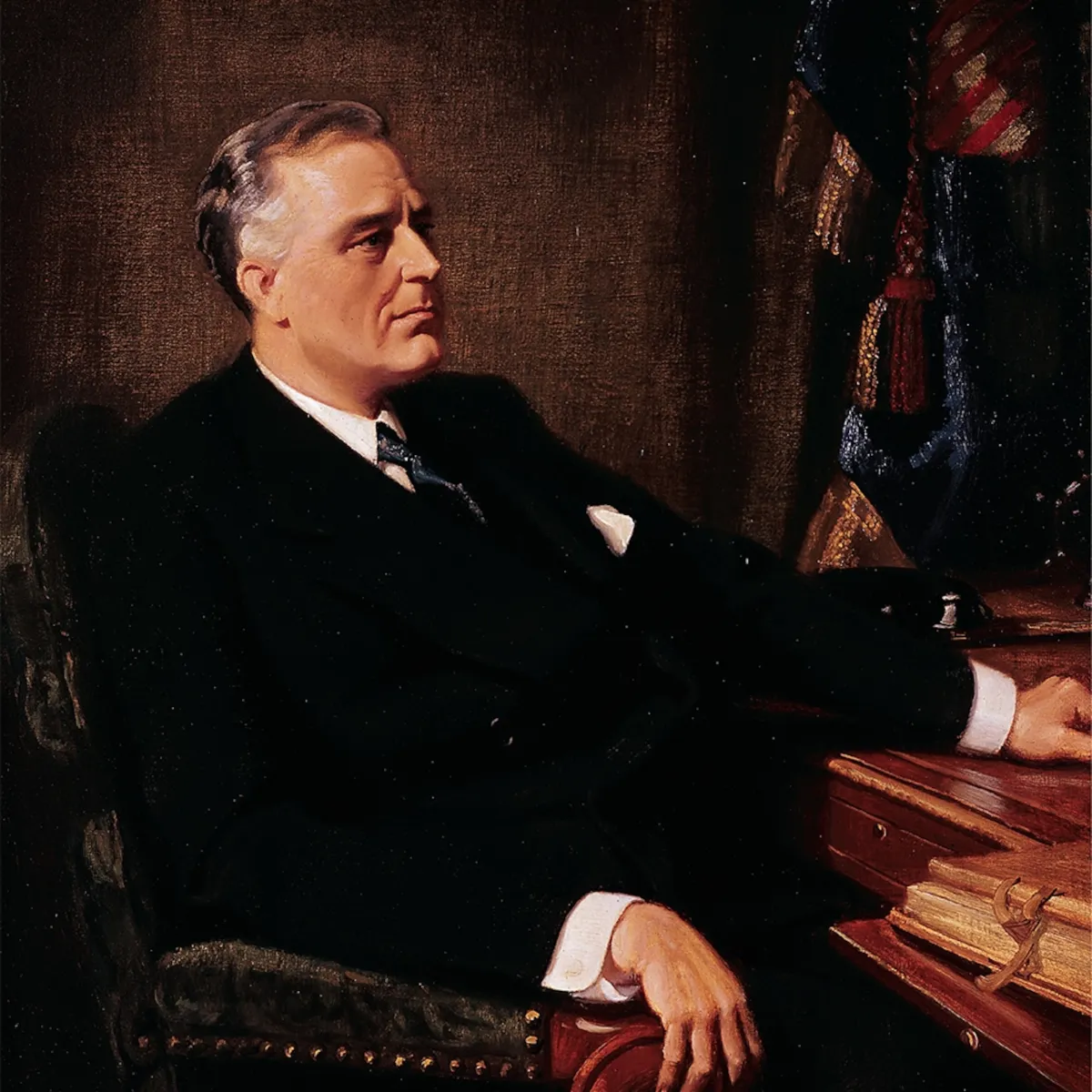 Photo: Franklin Roosevelt, via i.natgeofe.com
The Roosevelt administration's adoption of the Prussian model reveals how policy innovations spread through administrative convenience rather than local optimization. Rather than conducting original analysis of American demographics and fiscal capacity, New Deal architects imported a ready-made system that had achieved political success in Germany. The age 65 threshold came with built-in legitimacy—it had worked elsewhere, which eliminated the need to justify a new number.
This pattern of policy importation without contextual adaptation explains much about how arbitrary administrative decisions become sacred social contracts. The Social Security Act's framers weren't trying to deceive American workers, but they were adopting a system whose original logic depended on demographic assumptions that no longer applied.
The Mythology of Earned Leisure
Over the subsequent decades, age 65 retirement evolved from administrative convenience into cultural orthodoxy. American workers began organizing their entire financial lives around the assumption that they would stop working at 65 and live comfortably for another fifteen to twenty years. This expectation represented a complete inversion of the system's original logic—what Bismarck designed as an unlikely benefit became the central organizing principle of American working life.
The transformation reveals how quickly invented traditions acquire the psychological weight of natural law. Workers who had no knowledge of Bismarck's actuarial calculations began treating 65 as the natural endpoint of productive life. Employers structured pension systems around this arbitrary threshold, and financial advisors built retirement planning models that assumed decades of post-work leisure.
By the 1970s and 1980s, the idea of working past 65 had become culturally suspect in many industries. Workers who continued past the traditional retirement age were often viewed as either financially desperate or psychologically unable to embrace leisure—both seen as personal failures rather than rational responses to individual circumstances.
The Mathematics of Modern Longevity
Contemporary demographic realities have rendered Bismarck's original calculation completely obsolete. Americans now routinely live into their eighties, meaning that workers who retire at 65 can expect two decades of post-work life. This longevity represents a fundamental shift in the economic equation—what was once a rare bonus has become a standard expectation requiring massive financial preparation.
The fiscal implications would have horrified Bismarck's budget planners. Modern Social Security supports millions of beneficiaries for decades, creating exactly the kind of long-term financial obligation that the original system was designed to avoid. The program's current structure reflects the demographic assumptions of 1889 Prussia applied to the longevity realities of 21st-century America—a mismatch that creates persistent financial strain.
Yet attempts to adjust the retirement age to reflect modern life expectancy encounter fierce political resistance. Workers who have spent decades planning around age 65 retirement view any proposed changes as betrayals of promises made to them, even though those promises were based on demographic assumptions that ceased being accurate generations ago.
The Persistence of Convenient Fictions
The retirement age debate illustrates a broader truth about how societies handle inherited policy structures. Once administrative decisions become embedded in personal financial planning and cultural expectations, they develop a resistance to modification that has little relationship to their original logic or continued utility.
American workers defend the 65-year retirement threshold not because they understand its historical origins or current fiscal sustainability, but because their personal plans depend on its continuation. The system has created millions of stakeholders who have rational individual interests in maintaining an arrangement that may no longer serve broader social or economic purposes.
This dynamic explains why policy reform often requires crisis-level pressure to overcome institutional inertia. The gap between current demographic realities and inherited administrative structures can widen for decades before reaching a breaking point that forces systematic reconsideration.
The Legacy of Actuarial Deception
Bismarck's retirement innovation succeeded precisely because it promised something that seemed valuable while delivering something that cost almost nothing. The American adoption of his framework succeeded for different reasons—it provided a concrete goal around which workers could organize their financial planning and employers could structure their benefit systems.
The irony is that both versions of the system achieved their intended political effects while creating long-term fiscal challenges that their designers never anticipated. Bismarck's system eventually became expensive as German longevity improved, and America's version became expensive almost immediately because it was imported without adjusting for different demographic conditions.
The broader lesson extends beyond retirement policy to any administrative decision that becomes culturally embedded. What begins as bureaucratic convenience can evolve into social orthodoxy that resists modification long after its original justification has disappeared. Understanding this process helps explain why so many policy debates focus on defending existing arrangements rather than optimizing for current conditions.